

TWO PIECE ALLOY RETURN ROLLS
Return Rolls
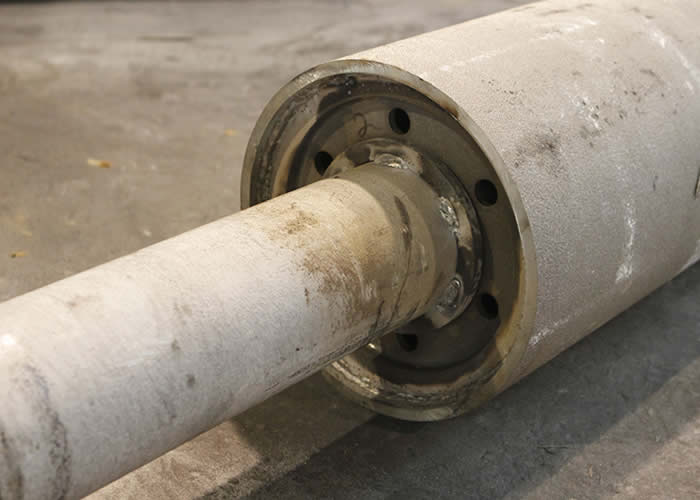
Return rolls are like hearth rolls in tube size and trunnion type. They have an extra support tube that holds the belt and gives clearance for the side links.
We make our return rolls with a two-piece design that includes one center tube supporting the larger outer tube. The benefit of our design is that if either tube should be damaged (e.g., a broken trunnion or distorted contact tube), we can repair the assembly at less expense than replacing the entire roll.
Cast-link belts over 48 inches wide (and many 48-inch belts) should use return rolls instead of skid tiles.
In synchronized furnaces, return rolls should also be synchronized with hearth rolls to reduce stress on the belt.
Synchronized Rolls
In the late 1990’s a new design of cast-link furnace was placed into service. This 54”-wide furnace, in the following years, would prove to be the best of this type of equipment yet produced. The unique feature of this furnace was that the rolls, along with the drive drum, were synchronized to turn at the same rate (ft/min). This uniform velocity meant that the belt floated over the rolls; thus, any stress on the pins and links was at an absolute minimum.
The result of this engineering was a furnace that was able to heat-treat 225 million pounds with very little maintenance. When they removed the first belt from service, it was due to alloy attrition, not excessive stretching or loss of pitch. Not only was belt life dramatically increased, but also the ability to control belt tracking increased.
Many existing furnaces can be retro-fitted with synchronized rolls for the hearth, and, in most cases, return rolls can be added in place of skid tiles or rails. The increase in belt life and lower operational maintenance of these upgraded furnaces more than warrant the cost of the rework.
Accuracy is critical in a synchronization project. Therefore, hearth and return rolls should be machined to maintain, plus-or-minus, ten-thousandths of an inch total variation with each other. In addition, it is necessary to minimize any out-of-sync condition because any error could multiply stress by a factor of three. Thus, tubes used in “as-cast” condition with a tolerance of one-sixteenth then the roll circumferences throughout the hearth could vary by three-sixteenths. Over many furnace cycles, this is enough to reduce belt life substantially.